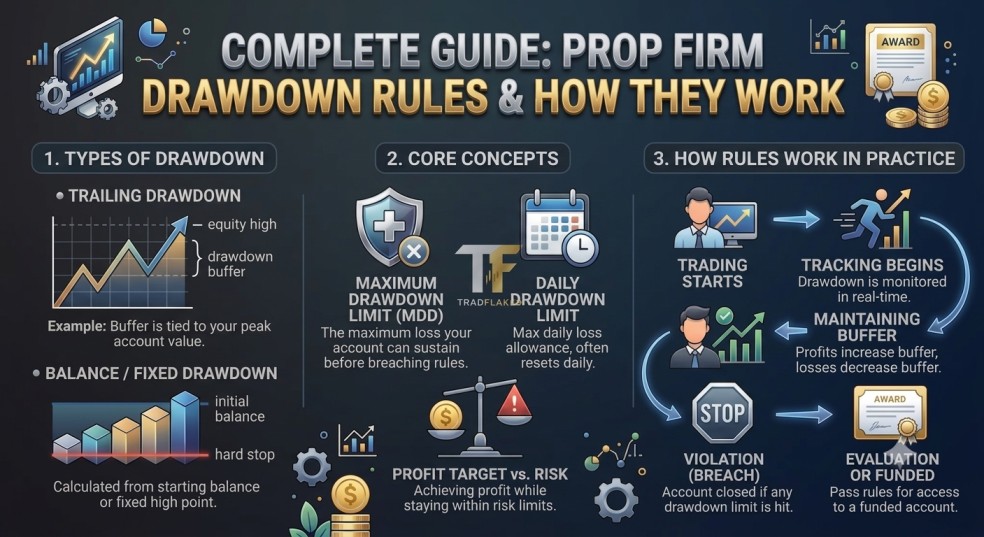
What Are Drawdown Rules in Prop Firms? A Complete Guide With Examples
One of the first things a trader notices when comparing prop firms is the account size: $10,000, $50,000, $100,000, $200,000 and sometimes much more. But the account size is not the number you should focus on first. The more important question is:
How much can the account actually lose before the prop firm considers the account breached?
That is where drawdown rules become critical. A prop firm may advertise a $100,000 account, but if the maximum loss is $10,000, your practical risk budget is determined by that $10,000 loss limit—not simply by the $100,000 headline account size. And even that is not enough information.
You also need to understand how the drawdown is calculated, what balance or equity is used, whether the limit trails your profits, when the limit moves, and whether floating profit can move the drawdown threshold. These details can completely change how a trader should manage an account.
What Is Drawdown in Prop Firm Trading?
In simple terms, drawdown is the decline in an account from a previous high point to a lower point. For example, suppose a trading account starts at $100,000.
- The account rises to $105,000.
- It then falls to $102,000.
- The drawdown from the peak is $3,000.
The basic calculation is:
Drawdown = Previous Peak − Current Account Value In this example:
$105,000 − $102,000 = $3,000 That is a $3,000 drawdown from the peak. However, a prop firm's maximum drawdown rule is slightly different from simply measuring how far your account has fallen. It defines the point at which your account is considered to have violated the firm's risk limit.
Drawdown vs Maximum Drawdown: They Are Not the Same Thing
This distinction causes considerable confusion.
Drawdown describes a decline in account value. Maximum drawdown or a maximum loss limit is the boundary imposed by the prop firm. For example, imagine a $100,000 account with a $10,000 maximum loss limit. If the account falls to $96,000, the trader has experienced a $4,000 loss from the starting balance.
If the firm's maximum loss limit is $90,000, the account has not breached the maximum-loss rule yet. But if the account falls below $90,000, the maximum-loss rule would be breached under that hypothetical rule structure. The critical point is that the $90,000 boundary may not always remain fixed. That depends on the type of drawdown used by the prop firm.
The Main Types of Prop Firm Drawdown Rules
Although individual firms can use different terminology and combinations of rules, traders will commonly encounter these mechanisms:
- Static or fixed drawdown
- End-of-Day (EOD) trailing drawdown
- Intraday trailing drawdown
- Daily loss / daily drawdown limits
Understanding the difference between these models is more important than simply seeing a headline such as “10% maximum loss.”
1. Static Drawdown
A static drawdown does not move upward when the account makes a profit. Suppose you have:
- Starting balance: $100,000
- Maximum loss: 10%
- Maximum loss amount: $10,000
The loss boundary is:
$100,000 − $10,000 = $90,000 If the account later increases to $105,000, the static loss boundary may remain at $90,000, assuming the firm's rules are structured this way. Now imagine the account falls:
- Peak: $105,000
- Current balance: $97,000
- Decline from peak: $8,000
The trader has experienced an $8,000 drawdown from the peak, but the account is still $7,000 above the hypothetical $90,000 maximum-loss boundary. This illustrates an important concept: Drawdown from your trading peak and the prop firm's maximum-loss boundary are not necessarily the same calculation.
Static drawdown example
| Account event | Account value | Maximum-loss boundary |
|---|---|---|
| Starting account | $100,000 | $90,000 |
| Profit | $103,000 | $90,000 |
| More profit | $108,000 | $90,000 |
| Pullback | $104,000 | $90,000 |
| Larger pullback | $96,000 | $90,000 |
Under this hypothetical structure, the loss boundary stays at $90,000 even though the account has reached $108,000.
2. End-of-Day Trailing Drawdown
This is where the calculation becomes more complicated. With an End-of-Day trailing drawdown, the drawdown threshold can move upward based on the account's performance at a defined end-of-day calculation point.
The important word is End-of-Day. The threshold generally does not continuously follow every intraday high. Instead, the firm's rules specify a particular calculation time and methodology. For example, suppose a hypothetical prop firm uses:
- Starting balance: $100,000
- Maximum drawdown: $10,000
- Trailing calculation: end of trading day
Initially:
$100,000 − $10,000 = $90,000 Now imagine the trader finishes Day 1 at $103,000. The next calculation could move the loss threshold to:
$103,000 − $10,000 = $93,000 If the trader later makes $4,000 more and finishes another day at $107,000, the threshold could move to:
$107,000 − $10,000 = $97,000 Now the trader has a much smaller buffer than they might expect from looking only at the original $100,000 account size.
Why EOD trailing drawdown surprises traders
Consider this sequence:
- Starting balance = $100,000
- Maximum loss = $10,000
- Day 1 closes at $103,000
- Day 2 closes at $107,000
- Trailing threshold = $97,000
The trader may think:
“I started with $100,000 and have made $7,000. I have a $10,000 loss limit, so I should have plenty of room.” That conclusion can be wrong under a trailing model. If the active threshold has moved to $97,000, the account may have only $10,000 of room between the current $107,000 balance and the threshold.
And if the account subsequently drops from $107,000 to $98,000, the trader has given back $9,000 of profit while coming very close to the $97,000 boundary.
3. Intraday Trailing Drawdown
Intraday trailing drawdown can be considerably more sensitive because the threshold can move during the trading session rather than waiting for an end-of-day calculation. This is especially important when the firm's methodology considers equity or unrealized profit. Consider this hypothetical example:
- Starting balance: $100,000
- Trailing drawdown amount: $5,000
- Initial threshold: $95,000
The trader opens a position. At one point, the open position shows:
+$4,000 floating profit If the firm's rules use intraday equity peaks for trailing purposes, that temporary high can potentially affect the trailing threshold. Then the market reverses. The trader's position goes from +$4,000 to −$1,000. The trader may think:
“I only lost $5,000 from the best unrealized point.” But under an equity-based trailing model, the temporary unrealized peak may have already caused the drawdown threshold to move. This is why traders need to know whether a prop firm trails from:
- Balance
- Equity
- Closed profit
- End-of-day balance
- End-of-day equity
- Intraday equity high
These are materially different mechanisms.
4. Daily Loss Limit vs Maximum Drawdown
Another common mistake is treating daily loss and maximum drawdown as the same rule. They are usually separate restrictions. A prop firm can have both:
- A maximum amount you can lose in a single trading day
- A maximum amount you can lose overall
For example, a hypothetical $100,000 account could have:
- Daily loss limit: $5,000
- Maximum loss: $10,000
The first rule controls the loss for a particular trading day. The second controls the overall account loss. FTMO's current rules provide a real-world example of this distinction: its 2-Step model lists a 5% Maximum Daily Loss and a 10% Maximum Loss, with the daily limit calculated using the relevant daily starting balance and equity including floating P/L, commissions and swaps.
How Daily Loss Limits Are Actually Calculated
Suppose a hypothetical firm has:
- Initial balance: $100,000
- Daily loss limit: 5%
The daily loss allowance is:
$100,000 × 5% = $5,000 On Day 1, the effective daily floor could therefore be:
$100,000 − $5,000 = $95,000
But what happens if you make money on Day 1? Suppose you finish the day with a balance of $103,000. If the firm's formula uses the new day's starting balance, the next day's threshold could become:
$103,000 − $5,000 = $98,000 FTMO currently describes its daily-loss calculation this way for its 2-Step Challenge: the limit is recalculated at midnight using the account balance at that time minus 5% of the initial simulated capital. This means a trader should never assume that yesterday's daily-loss boundary is still today's boundary.
Balance vs Equity: The Difference Can Save or Break an Account
This is one of the most important sections for traders. Balance generally reflects realized results after trades have been closed.
Equity generally includes the effect of open positions. A simplified formula is:
Equity = Balance + Floating P/L Commissions, swaps and other account adjustments can also matter depending on the firm's rules. Suppose:
- Balance = $100,000
- Open position floating loss = −$4,000
Then:
Equity = $96,000 If the firm's loss limit is checked against equity, the $96,000 figure matters even though the balance still says $100,000. FTMO explicitly states that its Maximum Daily Loss uses equity, including open-position floating P/L, commissions and swaps.
What Happens If You Are Profitable?
This is where trailing drawdown becomes particularly important. Imagine a hypothetical account:
- Starting balance = $50,000
- Trailing drawdown = $2,500
Initial drawdown floor:
$50,000 − $2,500 = $47,500 The trader makes $3,000. Account:
$53,000 If the rule trails from the relevant peak, the threshold may move upward. If the trader then loses $2,000:
$53,000 − $2,000 = $51,000 The trader is still profitable compared with the original $50,000 starting balance. But that does not automatically mean the account is safe. The relevant question is:
Where is the current drawdown threshold? This is the fundamental difference between account profitability and distance from the breach level.
Why a Profitable Trader Can Still Breach a Trailing Drawdown
Consider this example:
| Stage | Account value | Comment |
|---|---|---|
| Start | $100,000 | Initial account |
| Profit | $104,000 | Account is profitable |
| More profit | $108,000 | New peak |
| Pullback | $103,000 | $5,000 decline from peak |
| Further loss | $99,000 | Account still near starting balance |
The trader may think:
“I'm still basically around breakeven, so I should be fine.” That is not necessarily true. If the prop firm's trailing boundary moved upward as the account reached new highs, the trader must compare the current equity against the active trailing threshold, not merely against the original $100,000 starting balance.
Illustrative Drawdown Comparison
The following chart uses a hypothetical $100,000 account with a $5,000 drawdown allowance to demonstrate how different mechanisms can react differently to the same account growth. Important: this chart is a conceptual illustration. Actual firms can calculate and update their limits differently, including different treatment of balance, equity, unrealized P/L and timing.
End-of-Day Trailing vs Intraday Trailing
These two terms sound similar, but the practical difference can be significant.
| Feature | EOD trailing | Intraday trailing |
|---|---|---|
| When threshold normally updates | At a defined end-of-day calculation | During the trading session |
| Can intraday gains matter immediately? | Usually not in the same way | Potentially yes |
| Importance of unrealized P/L | Depends on the firm's methodology | Can be very important |
| Risk during a fast reversal | Depends on the current threshold | Can be particularly significant |
Topstep's current materials, for example, describe its Trading Combine Maximum Loss Limit as an End-of-Day trailing mechanism, while its rules also specify how the limit is checked and how unrealized P/L interacts with the account.
What Does "Trailing" Actually Mean?
A trailing drawdown means the loss boundary can follow account growth according to the firm's specified calculation. Think of it as a moving floor. With a static rule:
Your floor stays in one place. With a trailing rule:
Your floor can move upward as the account reaches qualifying highs. The key question is therefore not simply:
“How much is the drawdown?” Instead, ask:
“What event causes the drawdown threshold to move?” Possible triggers include:
- End-of-day balance
- End-of-day equity
- Intraday balance
- Intraday equity
- Realized profit
- Unrealized profit
- Specific profit milestones
Does Floating Profit Increase the Drawdown?
It depends entirely on the firm's rules. This is one of the most dangerous assumptions to make. Consider a trader whose balance is $100,000. An open position reaches +$5,000. Equity therefore reaches $105,000. The trader does not close the position. The market reverses and the position falls to −$1,000.
Whether that temporary $105,000 peak affects the drawdown calculation depends on the prop firm's specific methodology. Under an equity-based intraday trailing model, it can matter substantially. Under a balance-based or EOD model, the treatment can be different. Never assume that an unrealized profit is irrelevant—or that it automatically moves the limit.
What Happens to Drawdown When You Hold a Trade Overnight?
Overnight positions introduce another layer of risk. A prop firm's daily-loss calculation may reset at a specific time zone rather than at midnight in your local time. For example, FTMO states that its Maximum Daily Loss is recalculated at midnight Central European Time and specifically warns traders holding overnight positions that the new daily limit can interact with existing floating losses.
Consider a simplified example:
- Balance before reset: $102,000
- Floating loss: −$3,000
- Equity: $99,000
After the daily reset, the firm's new daily-loss threshold may be calculated from the new starting balance. If the open position then loses another $3,000, equity becomes $96,000. The trader therefore needs to understand both the reset time and the equity calculation. Never manage an overnight position using only the displayed balance.
Can a Prop Firm's Drawdown Limit Move Down?
This depends on the specific rule. Some trailing systems are designed so that the threshold only moves upward and does not move back down after the account declines. For example, FTMO currently states that its Maximum Loss Limit is recalculated from qualifying end-of-day balance levels and that the calculated limit can increase but not decrease. But this should not be generalized to every prop firm.
When evaluating a firm, look specifically for wording such as:
- Trailing drawdown
- High-water mark
- Maximum loss limit
- End-of-day trailing
- Intraday trailing
- Equity-based trailing
- Balance-based trailing
What Is a High-Water Mark?
A high-water mark is the highest account value used by a particular rule to determine the trailing threshold. Suppose a hypothetical rule trails by $5,000. The account reaches:
- $100,000 initially
- $103,000 later
- $106,000 after further profit
If $106,000 becomes the relevant high-water mark, a simplified trailing calculation would be:
$106,000 − $5,000 = $101,000 The important question is whether the firm's high-water mark is based on balance or equity and exactly when it is recorded.
Drawdown Example: Why Risk Per Trade Matters
Suppose you have:
- Account size: $100,000
- Maximum drawdown: $5,000
- Risk per trade: $1,000
You effectively have five full losing trades before reaching the $5,000 drawdown allowance—assuming there are no other losses, fees, slippage, daily limits or trailing effects. But if your risk per trade is $2,000:
$5,000 ÷ $2,000 = 2.5R That means only two full losses would consume $4,000 of the available drawdown, leaving just $1,000 of room. So the advertised account size is not enough to determine appropriate position size. Your position sizing should be based on the actual remaining drawdown buffer.
Drawdown Buffer: The Number Traders Should Monitor
A useful concept is the drawdown buffer. A simplified formula is:
Drawdown Buffer = Current Equity − Active Drawdown Threshold Example:
- Current equity = $103,000
- Active drawdown threshold = $98,000
Therefore:
$103,000 − $98,000 = $5,000 Your practical remaining buffer is $5,000. This number can be more useful for risk management than the original account size.
Why Traders Misread "10% Drawdown"
Suppose a prop firm advertises:
10% maximum drawdown A trader may immediately calculate:
$100,000 × 10% = $10,000
But that only answers one question: what is the nominal drawdown amount? You still need to know:
- Is the $10,000 limit static?
- Does it trail?
- Does it trail from balance or equity?
- Does unrealized profit count?
- Does the threshold move intraday?
- Does it update once per day?
- Does it stop trailing after reaching a certain level?
- Are commissions and swaps included?
- What timezone determines the daily reset?
- Does the rule change after a payout?
- Is there a separate daily loss limit?
Without those answers, the phrase "10% drawdown" is incomplete information.
Drawdown and Daily Loss Can Interact
Imagine a hypothetical $100,000 account with:
- Maximum drawdown: $10,000
- Daily loss limit: $5,000
The trader loses $4,000 on Monday. The trader has not necessarily breached either rule. On Tuesday, the trader loses another $4,000. Total account decline:
$4,000 + $4,000 = $8,000 The account could still be above its overall maximum-loss threshold. However, the trader must separately satisfy Tuesday's daily-loss rule. This is why traders should track daily loss headroom and overall drawdown headroom separately.
What Happens When You Hit a Drawdown Limit?
The consequence depends on the prop firm's rules. Some limits are hard breaches that can result in the account being considered failed. Other risk controls can be soft limits that flatten positions and temporarily prevent further trading.
For example, Topstep's current Live Funded Account rules state that reaching its Daily Loss Limit causes positions to be flattened and trading to pause until the next session, and describe that event as a soft breach rather than an account-ending violation. Its Maximum Loss Limit is treated separately. Other firms and other account stages can use different consequences.
Therefore, traders should never assume that "breaching a daily loss" automatically means the same thing everywhere.
How Should Traders Read a Prop Firm's Drawdown Rule?
Before purchasing an evaluation, answer these questions in order.
1. What is the maximum loss amount?
Convert the percentage into actual money. For a $100,000 account with a 10% maximum loss:
$100,000 × 10% = $10,000
2. Is the drawdown static or trailing?
This determines whether your profitable performance can move the loss boundary.
3. What does the drawdown trail?
Check whether it follows:
- Balance
- Equity
- End-of-day balance
- End-of-day equity
- Intraday equity
4. When does the threshold update?
Look for the exact calculation time.
5. What counts toward the loss?
Check whether the calculation includes:
- Closed P/L
- Floating P/L
- Commissions
- Swaps
- Other fees
6. What timezone is used?
A daily loss reset at a firm's server time may occur at a different local time for you.
7. Does the threshold ever stop trailing?
Some systems can eventually lock the drawdown at a particular level. Others may continue using their trailing methodology.
8. What happens after a payout?
Some firms can change account values, thresholds or available capital following withdrawals.
9. Is there a separate daily loss rule?
A maximum drawdown does not automatically tell you how much you can lose in one day.
A Practical Drawdown Calculation Example
Let's put everything together using a completely hypothetical account.
Account: $100,000
Maximum loss: $6,000
Daily loss: $3,000
Drawdown methodology: EOD trailing
Trailing basis: end-of-day balance
Day 1
Starting balance = $100,000. Maximum-loss floor:
$100,000 − $6,000 = $94,000 The trader finishes the day at $102,000.
Day 2
If $102,000 becomes the new qualifying EOD balance:
$102,000 − $6,000 = $96,000 The trader's maximum-loss floor has moved from $94,000 to $96,000. Now suppose the account rises to $105,000 during Day 2 but finishes the day at $103,000. If the rule uses end-of-day balance, the relevant new high may be $103,000 rather than the temporary $105,000 intraday value.
That distinction is exactly why traders need to read the methodology rather than relying on the word "trailing."
What Traders Should Do Differently Under a Trailing Drawdown
Trading under a trailing drawdown requires more than simply saying, "I will risk 1% per trade."
The account's remaining drawdown buffer should influence risk. Suppose your current equity is $103,000 and the active drawdown floor is $99,000. Your available buffer is:
$103,000 − $99,000 = $4,000 If you normally risk $1,000 per trade, a four-loss sequence could theoretically consume the entire remaining buffer. If your strategy experiences normal losing streaks of five or six trades, that risk level may be incompatible with the account's current drawdown state. This is why traders should think in terms of:
Risk per trade ÷ Remaining drawdown buffer rather than only:
Risk per trade ÷ Account size
Common Drawdown Mistakes Traders Make
Mistake 1: Treating the account size as the real risk capital
A $100,000 prop account is not necessarily equivalent to having $100,000 of loss capacity. The maximum-loss rule determines the actual loss boundary.
Mistake 2: Ignoring floating P/L
If the rule is equity-based, an open losing position can consume your available buffer even before you close it.
Mistake 3: Assuming trailing drawdown means the same thing everywhere
Trailing from end-of-day balance is fundamentally different from trailing intraday equity.
Mistake 4: Forgetting commissions and swaps
A trader may calculate a position's P/L while ignoring costs that are included in the firm's risk calculation.
Mistake 5: Ignoring the reset time
Daily-loss rules are often tied to a specific server or market timezone.
Mistake 6: Increasing position size after making profits
Under a trailing model, making more money does not necessarily mean your risk buffer has increased by the same amount.
Mistake 7: Looking only at balance
Balance can look safe while equity is approaching the loss boundary.
Mistake 8: Holding large positions through volatile events
A temporary equity spike followed by a sharp reversal can interact badly with equity-based trailing rules.
Drawdown Checklist Before Choosing a Prop Firm
Before paying for an evaluation, create a small rule sheet containing these fields:
| Question | What to record |
|---|---|
| Maximum loss | Percentage and dollar amount |
| Drawdown type | Static / EOD trailing / intraday trailing |
| Trailing basis | Balance / equity / other |
| Daily loss | Percentage and dollar amount |
| Daily reset | Exact time and timezone |
| Floating P/L | Included or excluded |
| Commissions | Included or excluded |
| Swaps / financing | Included or excluded |
| High-water mark | How it is established |
| Trailing stop | When and how it moves |
| Locking mechanism | Whether trailing eventually stops |
| Payout impact | Whether withdrawal changes limits |
| Breach consequence | Soft restriction or account failure |
Frequently Asked Questions About Prop Firm Drawdown Rules
What is a drawdown rule in a prop firm?
A drawdown rule defines how much an account can decline before a prop firm's loss limit is breached. The rule can be static or trailing and may be calculated from balance or equity depending on the firm.
What is a 10% drawdown on a $100,000 prop firm account?
A 10% drawdown corresponds to $10,000. But the actual loss boundary depends on the firm's methodology. A static $10,000 limit and a $10,000 trailing limit can produce very different trading conditions.
What is the difference between daily loss and maximum drawdown?
Daily loss limits restrict how much you can lose during a defined trading day. Maximum drawdown or maximum loss controls the broader account-level loss boundary. A firm can have both rules simultaneously.
Does floating loss count toward prop firm drawdown?
It depends on the firm's rules. If the limit is based on equity, floating P/L can affect the calculation. If it is based on balance, the treatment can be different.
Does floating profit affect trailing drawdown?
It depends on whether the firm uses balance, equity, end-of-day values or intraday high-water marks. An intraday equity-based trailing system can treat temporary unrealized highs differently from an EOD balance-based system.
What is trailing drawdown?
Trailing drawdown is a loss boundary that can move upward as the account reaches qualifying profit or equity levels. The exact event that moves the threshold depends on the prop firm's rules.
What is EOD trailing drawdown?
EOD, or End-of-Day, trailing drawdown means the firm's trailing calculation is updated at a defined end-of-day point rather than continuously following every intraday account high.
What is intraday trailing drawdown?
Intraday trailing drawdown can update during the trading session based on the firm's specified balance or equity methodology. If unrealized equity highs are included, temporary floating profits can affect the active threshold.
Can I be profitable and still breach a prop firm drawdown rule?
Yes. Under a trailing model, the relevant comparison is between your current account value and the active drawdown threshold. Being above the original starting balance does not automatically mean the account is safe.
Does drawdown reset every day?
Not necessarily. Daily loss limits commonly have a reset or recalculation period, but maximum drawdown can remain active throughout the account's lifecycle. The exact behavior depends on the firm's rules.
Does drawdown increase when I make profit?
Under a trailing drawdown model, the loss threshold can move upward as the account reaches qualifying highs. Under a static model, it may remain fixed.
What should I check before choosing a prop firm?
Do not compare only the advertised account size or maximum-loss percentage. Check the drawdown basis, trailing methodology, equity treatment, daily loss rule, reset time, commissions, swaps, payout effects and breach consequences.
Final Takeaway: The Drawdown Method Matters More Than the Headline Percentage
When traders compare prop firms, it is easy to focus on phrases such as:
"$100K account."
"10% maximum loss."
"5% daily drawdown." Those numbers are useful, but they do not tell the entire story.
The real question is how the loss boundary behaves while you trade. A trader should know:
- Where the drawdown starts
- How large the loss allowance is
- Whether the limit is static or trailing
- Whether trailing is based on balance or equity
- Whether unrealized P/L matters
- When the threshold moves
- When the daily loss resets
- What timezone controls the reset
- Whether commissions and swaps are included
- What happens after a payout
- What happens when a limit is reached
The most useful number to monitor while trading is often not the original account size. It is the distance between your current equity and the active loss boundary. Once you understand that number, you can calculate position size, evaluate losing-streak tolerance and understand how much room your strategy actually has.
In prop trading, understanding the drawdown mechanism is not a minor detail. It is part of understanding the account itself.
Want to Compare Prop Firms Before You Buy a Challenge?
Don't compare firms based only on account size or profit targets. Check the drawdown model, daily loss limit, payout rules and trading restrictions side by side.
Compare Prop Firms Side by Side →