How to Choose a Prop Firm: A Trader's Complete Guide to Picking the Right Fit
Choosing a prop firm is one of the most consequential decisions a funded trader will make — and yet most traders spend more time comparing profit-split percentages than actually reading the rules that determine whether they'll ever see that split. Whether you trade forex, indices, crypto, or commodities, the firm you choose should be built around how you already trade, not the other way around.
Every prop firm tells a story through its rulebook. Two firms can both advertise a "10% max drawdown" and a "90% profit split," yet behave completely differently once real money and real trading decisions are on the line. Beneath the marketing page lies a set of mechanics — drawdown type, consistency requirements, payout timing — that quietly decide whether a trader passes, gets funded, and actually gets paid. Understanding that story is what separates traders who choose deliberately from traders who choose by advertisement.
This guide explains how prop firm rules actually work, why the same-sounding rule can mean two very different things at two different firms, and how to match a firm's structure to your own trading style before you spend a single dollar on a challenge.
Why Most Traders Choose the Wrong Firm
The most common mistake isn't picking a "bad" firm — it's picking a firm whose rules don't match how you actually trade. A firm can be fully legitimate, well-reviewed, and reliable, and still be entirely wrong for you.
A swing trader who holds positions over the weekend will fail repeatedly on a firm that restricts overnight holding — not because they lack skill, but because the account type was never built for their style. A trader who has one exceptional day out of ten may hit the profit target technically, yet still get blocked by a consistency rule most beginners don't even know exists until it silently stops their payout.
A prop firm's rules don't predict whether you'll succeed. They simply define which style of trading is allowed to succeed — and that's exactly what you need to check before you buy.
Every Evaluation Is an Auction Between You and the Rulebook
It helps to think of a prop firm challenge the same way you'd think of any negotiation. Imagine applying for a loan. The bank doesn't just ask how much money you want — it asks how you'll repay it, how much risk you'll take on, and under what conditions the agreement falls apart. A prop firm challenge works the same way: you're not just being evaluated on whether you can make money, but on whether you can make it within a specific, pre-agreed set of boundaries.
Those boundaries — drawdown type, consistency rules, session restrictions — are rarely identical across firms, even when the headline numbers look the same. The firm that fits you isn't the one with the biggest funding number. It's the one whose boundaries match how you already trade.
Step 1: Understand the Two Core Evaluation Models
Almost every prop firm today runs one of two structures.
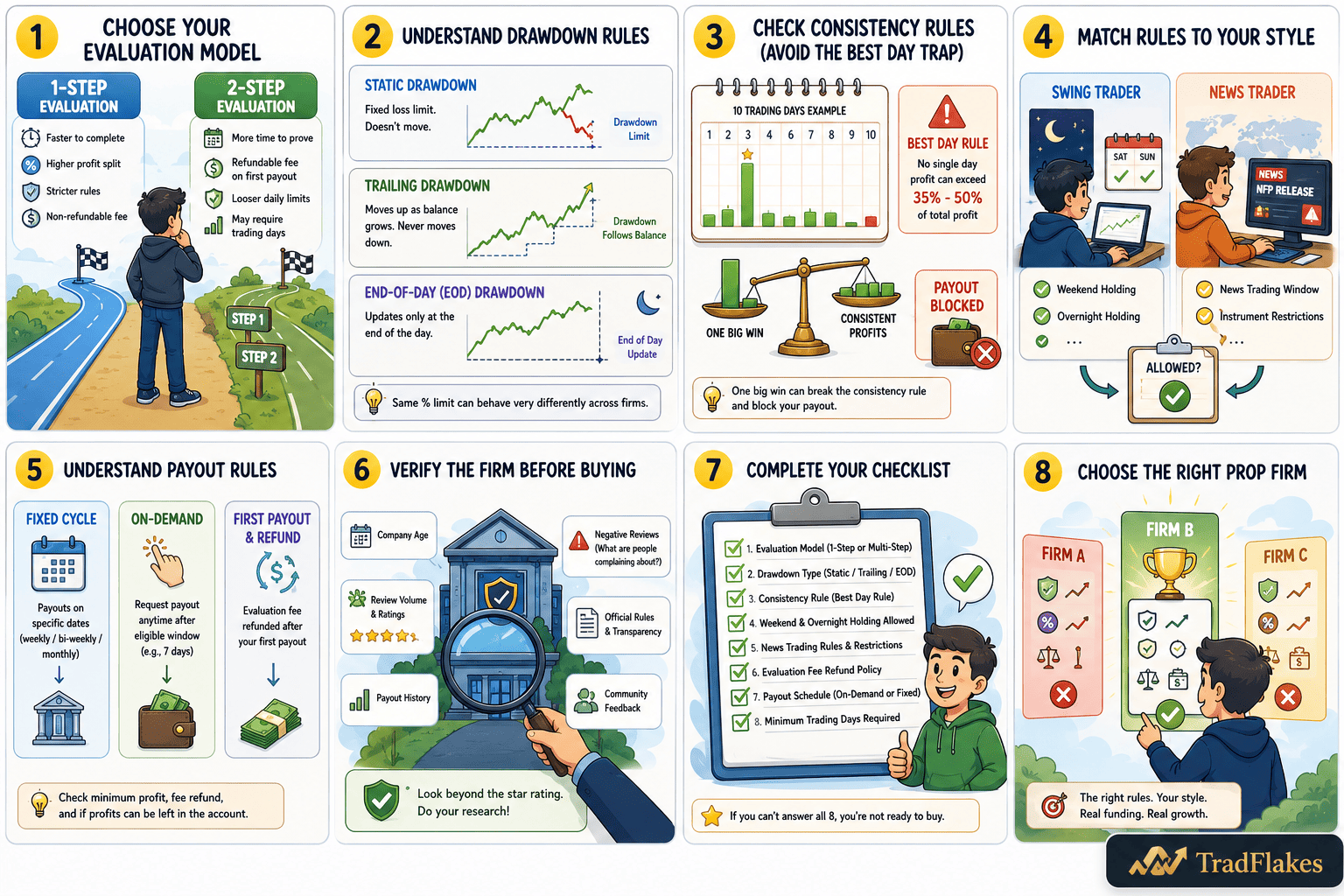
A 1-Step Evaluation is a single phase to prove yourself. It's faster to complete and often comes with a higher profit split — sometimes reaching 90% or more — but usually carries stricter day-to-day rules, tighter daily drawdowns, and sometimes a non-refundable fee even after passing.
A 2-Step (or multi-step) Evaluation splits the process across two or more phases, typically with declining profit targets in later phases. It usually offers looser daily limits, a refundable fee upon your first payout, and sometimes a minimum number of required trading days — paired with a lower starting profit split that scales upward over time.
Neither model is objectively better. A 1-Step suits traders confident in fast, controlled execution who want to start earning sooner. A 2-Step suits traders who prefer a longer runway to prove consistency and want their fee back eventually.
Step 2: Learn the Difference Between Drawdown Types
This is the single most misunderstood part of any prop firm's rulebook — and the one most likely to cause an unexpected failure.
A Static Drawdown is a fixed loss limit calculated once from your starting balance. It never moves. Simple to track, but it offers no extra cushion even after you've built up profit.
A Trailing (Dynamic) Drawdown rises as your balance grows, but — critically — never moves back down, even if you give back profits. This is the rule most traders misjudge. A strong early trading day can actually increase your risk of breaching later, because the floor has already locked in at a higher level. Many traders assume "trailing" means more forgiving; in practice, it can be stricter than a static limit once you've had a good run.
An End-of-Day (EOD) Dynamic Drawdown behaves similarly, but recalculates only once per day based on your closing balance, rather than moving in real time throughout the session — giving slightly more intraday breathing room than a live trailing calculation.
Don't just ask "what's the drawdown percentage." Ask what type of drawdown it is, and exactly when it locks. Two firms advertising the same 10% limit can behave in completely opposite ways once real trading begins.
Step 3: Check for Consistency Rules — The "Best Day" Trap
Some firms require that no single day account for more than a set percentage of total profit — commonly somewhere between 35% and 50%. This rule doesn't cause an outright failure the way a drawdown breach does, but it can quietly block your payout even after you've technically hit your profit target.
This catches traders who land one lucky, oversized winning day and assume they've already passed. In reality, they may need to keep trading profitably on smaller, more consistent days until the ratio balances out. If your results tend to include occasional large wins mixed with quieter days, check whether your target firm has this rule — and whether it applies during the evaluation, the funded stage, or both.
Step 4: Match the Firm's Asset and Session Rules to Your Style
Two areas trip up more traders than almost anything else in a prop firm's rulebook.
Weekend and overnight holding. If you're a swing trader who holds positions for days, confirm the firm explicitly allows overnight and weekend holding on the specific account type you're purchasing. Many firms restrict this by default on their standard tier, offering holding freedom only on a separate — sometimes pricier — account variant.
News trading. If your strategy involves trading around economic releases, check the exact restricted window, since this varies firm to firm. Also check whether the restriction applies only to specific instruments tied to that release, or blocks trading broadly — and critically, whether a triggered stop-loss or take-profit during that window counts as a violation. On some firms, it does, even if you never manually placed the trade.
Step 5: Understand the Real Payout Mechanics
Don't compare firms on headline profit-split percentages alone — dig into the mechanics underneath them.
Is there a fixed payout cycle, or can you request a payout on-demand once you clear a minimum eligibility window? Is there a minimum profit threshold required to request one? Can profits be left in the account to build a bigger buffer, or must they always be withdrawn? Is the evaluation fee refunded on your first payout, and does that differ by account type?
These details affect your actual cash flow far more than the advertised split percentage alone.
Step 6: Verify Legitimacy Beyond the Star Rating
A high review score is a good starting signal, but it isn't the whole picture.
Look at how long the firm has actually operated — firms with several years of continuous operation and no history of sudden shutdowns carry meaningfully less risk than brand-new entrants, no matter how aggressive their marketing. Look at review volume, not just review score — a 4.8 rating built on 40,000+ reviews is statistically harder to manipulate than the same score built on a few hundred. And read what the negative reviews actually describe: complaints about specific rule violations are a very different risk profile than complaints describing systemic payout refusal.
Total "amount paid out" figures are almost always self-reported by the firm itself. Treat them as a claim worth noting, not a confirmed fact, unless independently audited.
Step 7: Build a Simple Decision Checklist
Before purchasing any challenge, make sure you can answer every one of these for your specific chosen account type:
- Is it a 1-Step or multi-step evaluation?
- What type of drawdown applies — static, trailing, or EOD — and at what percentage?
- Is there a consistency or "Best Day" rule, and when does it apply?
- Are weekends and overnight positions allowed on this specific account type?
- What's the exact news trading restriction window, and which instruments does it cover?
- Is the evaluation fee refundable, and under what condition?
- What's the actual payout eligibility timing — truly on-demand, or a fixed cycle?
- Is there a minimum number of required trading days?
If you can't answer all eight of these from the firm's own official documentation before you buy, you're not ready to purchase — you're gambling on rules you haven't confirmed.
Final Thought
Prop firm marketing tends to emphasize the exciting parts — big funding numbers, high profit splits, fast payouts — because that's what converts a visitor into a signup. But the rules that actually determine whether you pass, get funded, and keep your account are almost always in the fine print: drawdown mechanics, consistency requirements, and session restrictions.
The traders who succeed with prop firms long-term aren't necessarily the most skilled. They're the ones who took the time to match a firm's actual rule structure to their own trading style before putting money down. Use the checklist above every time you evaluate a new firm, and you'll avoid the single most common and most avoidable reason traders fail — not a lack of skill, but a mismatch between their style and the rules they never fully understood going in.
Compare Prop Firms in Detail
Now that you know what to look for, put the checklist to use. Our prop firm comparisons break down account types, drawdown mechanics, consistency rules, and payout structures side by side, so you can shortlist firms based on facts instead of marketing:
- Prop Firm Comparison Hub — browse and compare every firm we cover, rule by rule — Our most viewed direct side-by-side matchup, if you're deciding between any of these:
- FundingPips vs The 5%ers
- FundingPips vs The 5%ers
- FundingPips vs FTMO
See Every Firm Side by Side
Prefer to compare numbers directly instead of reading rule by rule? Our Prop Firm Comparison Tool lays out profit targets, drawdown types, and payout splits across every firm we cover in one table, so you can shortlist your options in minutes.
Let Us Know Your Favourite Props, Why You Like Them Most
Every trader's ideal firm looks a little different depending on style, risk appetite, and what they've experienced firsthand. Have a prop firm that's worked well for you, or a lesson learned the hard way? Share your experience in the comments below — or reach out to us directly on X or Instagram. Real trader feedback helps the next person reading this make a more informed choice.
Explore More on TradFlakes
- All Prop Firm Reviews — browse our full directory of prop firm comparisons
- Broker Comparisons — compare trading conditions, fees, and platforms across top brokers
- Trading Guides — more educational content on evaluation rules, risk management, and platform selection
Bookmark this guide and revisit your checklist before every new challenge purchase — prop firm rules are updated periodically, so always confirm current terms directly on the firm's official site before signing up.